CustomsClear
Prices
|
CustomsClear
+370 664 26393info@customsclear.net

Company

  • About company
  • Team members
  • Authors
  • Terms of use
  • Privacy policy

Knowledge platform

  • About the platform
  • Articles
  • Journal
  • Videos
  • Courses
  • Events
  • Platform news
  • Glossary

AI assistants

  • Start free trial
  • Explore assistants
  • Classify AI
  • Smart Taric AI
  • Sanctions AI
  • News agent
  • Learning companion
  • About CustomsClear AI

Newsletter

Subscribe for the latest news, top reads, and handy resources

LinkedInFacebookYouTubeX

© 2026 CC Learning, UAB, All rights reserved.

Cookie preferences

We use essential cookies to ensure our website functions properly. We would also like to use analytics cookies to help us understand how visitors interact with our website, enabling us to improve your experience.

Until you choose, and if you decline, Google gets only basic visit information without cookies, so we can still count visits.

  1. Home
  2. Articles

Update on two pillars of the EU customs reform: the EU Customs Data Hub and the redefinition of the ‘importer’

Michael Lux
Attorney at Michael Lux BV, former Head of Unit ‘Customs Legislation’ and ‘Customs Procedures’, EU Commission, Michael Lux BV, Belgium
Published 24 Jun 2025
Update on two pillars of the EU customs reform: the EU Customs Data Hub and the redefinition of the ‘importer’
European Commission
Topic spotlight
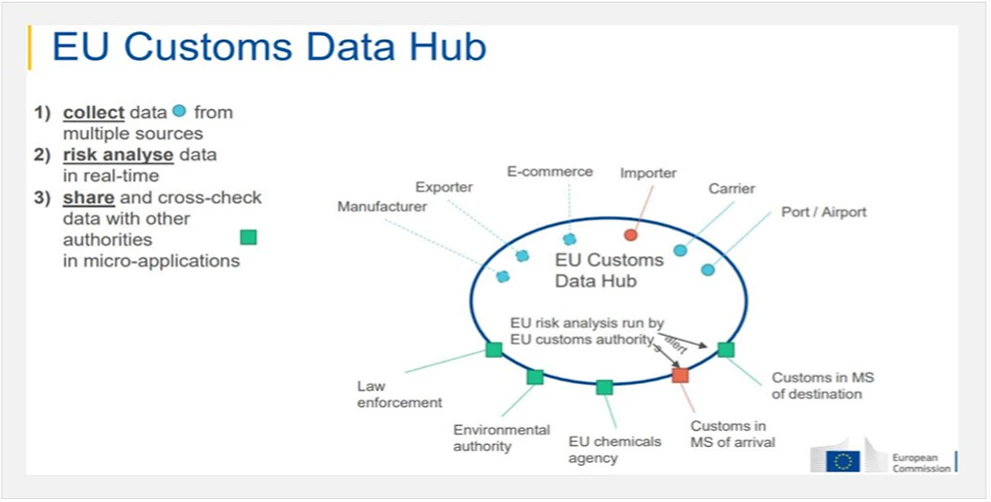
Under the Polish Presidency, which expires at the end of June, the Council was able to draw up a complete compromise text on the Commission's proposal of a new Union Customs Code (nUCC). Apart from further minor amendments until the Council's decision on a negotiating mandate, this text will – alongside the amendments adopted by Parliament in 2024 – form the basis for the trilogue negotiations between the Council, Parliament and the Commission under the Danish Presidency, which starts on 1 July 2025. Important changes compared to the Commission's proposal concern the deletion of the detailed provisions on penalties for customs infringements, the re-introduction of the temporary storage facility with a corresponding authorisation (and a retention period of 90 days), as well as the re-introduction of re-export as a non-customs regime; insofar the current legal situation will be largely retained. The status of the AEOC is also to be retained besides newly introduced so-called ‘Trust and Check Trader’ status. This paper therefore focuses on two aspects where significant changes can be expected in practice: the redefinition of the ‘importer’ and the gradual introduction of a central customs data hub to replace national customs clearance systems in the long term.

Member access

Please log in/register to view this free content.

Members have access to all videos, articles and online events! See membership plans

Already have an account?

Related content

EU Customs Reform & Data Hub: a turning point for European trade

EU Customs Reform & Data Hub: a turning point for European trade

Godfried Smit
Godfried Smit
05 Mar 2026

Godfried Smit, Secretary General of the European Shippers' Council, talks to Enrika Naujokė about the EU customs reform and what it means for businesses preparing for change - essential viewing…

Customs law
Digitalisation
Can the EU strike a balance between worker protection, innovation and global AI competitiveness?

Can the EU strike a balance between worker protection, innovation and global AI competitiveness?

Ramūnas Šablinskas
Ramūnas Šablinskas
13 Apr 2025·Updated 14 Oct 2026

Editor's note: Continuing the theme of the previous article (see 'Discussion of the most important AI risks'), the author looks at how the EU is trying to reconcile worker protection,…

Digitalisation
Perspective
How can you train an artificial intelligence system to do what you need?

How can you train an artificial intelligence system to do what you need?

Ramūnas Šablinskas
Ramūnas Šablinskas
12 Oct 2025·Updated 14 Oct 2026

This article aims to explain how artificial intelligence (AI) systems are trained, how they differ from traditional programmes, and - most importantly for your daily work - when they can…

Digitalisation
Perspective
How EurTradeNet International Association influences EU customs policy and system design

How EurTradeNet International Association influences EU customs policy and system design

Maite Miret
Maite Miret
11 Jan 2026

This interview with Maite Miret, General Manager and Secretary of the Board of EurTradeNet (ETN), looks at how a European association of customs IT service providers has shaped EU customs…

Digitalisation
Profession
EU Customs Data Hub: how the reform's core platform will work

EU Customs Data Hub: how the reform's core platform will work

Anthony Buckley
Anthony Buckley
11 Nov 2025

In this recording, Anthony Buckley (CEO, Anthony Buckley Consulting Ltd.; former Head of Ireland's Revenue Customs Service) delivers an in-depth overview of the EU Customs Data Hub, a central pillar…

Digitalisation
Exploring AI and its uses in customs practice

Exploring AI and its uses in customs practice

Ramūnas Šablinskas
Ramūnas Šablinskas
20 Apr 2025

In this recording, Dr Ramūnas Šablinskas, IT solution architect and technical product manager at CC Learning UAB (CustomsClear), explains how artificial intelligence (AI) works and how it can be used…

Digitalisation
Customs Compliance & Risk Management, Issue 33, June / July 2025
Michael Lux
Customs law
Digitalisation
Sanctions AI
Classify AI
Smart Taric AI